




Media & Entertainment industry versus Artificial Intelligence
That Artificial Intelligence (AI) has become a nuisance was validated by the Indian Government when the IT Rules, 2021 were modified on February 10, 2026 by the introduction of the Information Technology (Intermediary Guidelines and Digital Media Ethics Code) Amendment Rules, 2026 by the Ministry of Electronics and Information Technology (MeitY), and came into effect on February 20, 2026, ensuring that deepfakes and other prohibited synthetic content had to be removed within three hours by digital platforms.
Key learnings of this mandate included:
- 3-Hour Takedown: Intermediaries must disable access to unlawful content (including deepfakes/synthetic media) within three hours of receiving a written order from a court or from an authorized government agency.
- 2-Hour Takedown: For non-consensual sexual deepfakes, wherein the deadline is even more strict, requiring removal within two hours of a complaint.
- Scope: These rules apply to “synthetically generated information” (SGI) that is artificial, algorithmically created, or modified content that looks genuine.
- Consequences: Failure to comply with these timelines can lead to the loss of “safe harbour” protection under Section 79 of the IT Act, 2000 making digital platforms directly liable for user-generated content (UGC).
- Proactive Measures: Platforms are required to implement automated tools to detect and remove such content, and must label all “AI-generated content” as such.
This mandate drastically reduces the previous 36-hour window for content takedowns.
 Further, on February 23, 2026 artist representatives launched a ‘Say No To Suno’ campaign against digital platform suno.com (“Suno”), which boasts providing consumers the following opportunities: “Where you can discover, create and share from anywhere because music has no boundaries.”
A coalition of artist representatives has published an open letter calling on the music community to reject AI music generator Suno as an “AI slop (that) dilutes the royalty pools of legitimate artists from whose music this slop is derived”.
Published on February 23, 2026 on the Music Technology Policy blog, the letter was signed by industry representatives, including Ron Gubitz, Executive Director of the Music Artist Coalition; Helienne Lindvall, songwriter and President of the European Composer and Songwriter Alliance; and Chris Castle of the Artist Rights Institute.
In the open letter, the artist representatives described Suno as a “brazen smash and grab” platform, accusing it of using “unauthorized AI platform machinery trained on human artists’ work”. The full text can be read here: https://musictechpolicy.com/2026/02/23/open-letter-say-no-to-suno/.
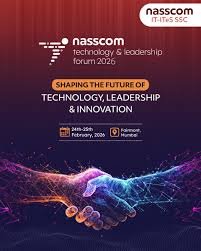
Meanwhile, closer home in Mumbai, the National Association of Software and Service Companies (Nasscom), established in 1988 and headquartered in New Delhi, the premier non-profit trade association and lobby group for the Indian Information Technology (IT) and Business Process Management (BPM) industry representing over 3,600 members, held the 34th edition of its Technology & Leadership Forum (NTL), on February 24–25, 2026. Under the theme “Tech-Driven, Human-Centered”, the forum also focused on ‘The soul in the system: music in the age of machines’.
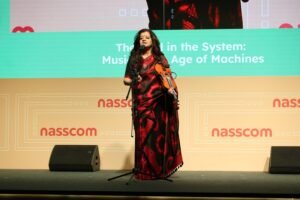 While there is no doubt that AI can integrate the seven basic notes of music (the Western diatonic scale as well as the Indian Swara system) by acting as an intelligent partner in composition, performance, and analysis, AI uses machine learning, deep neural networks, and pattern recognition to analyse musical data, understand harmonic rules, and generate melodies that may adhere to or creatively break traditional scale rules, which was amply brought to the fore during the session hosted by violinist Sunita Bhuyan.
Nevertheless, Sunita – basis her vocals, and talent in playing the violin – started her conversation with the audience by performing the widely recited, powerful Hindu prayer (stotra) dedicated to Lord Ganesha, ‘Vakratunda Mahakaya’’, often used as a morning prayer to start the day without obstacles, and with wisdom. Among various examples, Sunita also showcased how human inputs are essential in the creation of music characterized by the integration of emotional expression, intentionality, and physical interaction with instruments, rather than merely producing technically correct sounds. Unlike AI, which predicts patterns based on existing data, human input is driven by intuition, personal experience, and the capacity to mould musical rules for artistic effect.
From demonstrating Bollywood examples of popular songs that utilise ragas, to utilising Indian music notes while performing the theme song from ‘Titanic’ – which Sunita admitted her western classically trained son, a piano player, often says that there are several other songs that should be utilised as examples – Sunita also spoke about the universality of AI, but that “AI will always be a tool” supporting human creativity. Sunita went on to provide additional musical support with her violin across Scottish Gaelic sounds, to the sounds of folk from Assam, Sunita’s home state.
Supported by keyboardist Ameya Naik, who is also a percussionist, this was indeed an impressive session from NTL that effectively showcased human inputs that turn sound into art by imbuing it with human consciousness and experience, even though the media & entertainment may not always see eye-to-AI.


