



The New Age Composer: Now Fully Automated
After centuries of riyaz, discipline, broken strings, missed notes, rejected compositions, and the occasional existential breakdown over whether that chord should resolve or not… we have arrived at the ultimate destination of musical progress:
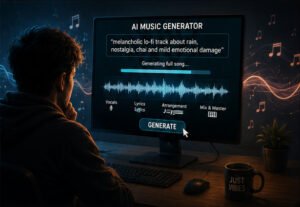
Typing a sentence…. Not writing. Not composing. Not even trial and error. Just… typing.
A carefully curated line like “melancholic lo-fi track about rain, nostalgia, chai, and mild emotional damage” is now apparently enough to summon a fully formed piece of music. Within seconds, you are presented with vocals, lyrics, harmony, arrangement, production, and a ready-made emotional arc—as if the machine has lived your life, processed your heartbreak, and decided to score it for you.
No practice. No theory. No failure. No growth… Just results.
It’s quite remarkable, really. For centuries, musicians believed—quite foolishly—that understanding music had something to do with making it. That knowing your instrument, studying harmony, or spending years refining your ear might be important. Turns out, all along, what we really needed was a text box and a decent vocabulary.
From Composition to Description
There was a time when composing meant making decisions. Real ones. You chose notes, shaped phrases, decided how tension builds and resolves, and understood why a certain instrument could break your heart in one register and sound ridiculous in another.
Today, the process has evolved.
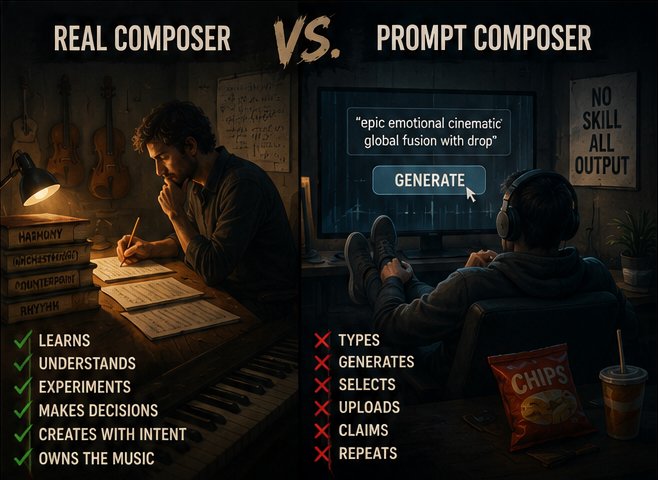
You describe what you want. Not how it works—just how it should feel. You type “epic, emotional, cinematic, global fusion with a powerful drop,” press generate, and then proceed to audition versions like you’re sampling snacks at a supermarket.
You reject one because it’s not emotional enough. Another because it’s too slow. A third because it doesn’t “hit.” Eventually, one of them does something vaguely satisfying, and that becomes your track. At no point did you decide why it works. But it works. And that’s enough. We’ve moved from composing music to approving it.
The Comfort of Not Knowing
To be fair, the technology is extraordinary. It can assemble structure, mimic genres, approximate emotion, and produce something that sounds convincingly like music with very little input. And that’s exactly where the danger lies. Because for the first time, you can completely bypass understanding and still arrive at something that sounds finished. You no longer need to know why a chord progression evokes sadness, or why certain instruments blend while others clash. You don’t need to think about voicing, dynamics, or phrasing.
The machine handles it.
All you need to do is react. And slowly, without realizing it, you stop asking questions. You stop being curious. You stop learning. Because the result is already there, waiting for your approval. Convenience, at this level, doesn’t just save time. It replaces the process.
 When Tools Stop Being Tools
Let’s be very clear about something that seems to be getting lost in all the excitement: “AI is a tool.”
It is not a composer. It is not a musician. It is not your artistic identity having a breakthrough moment. “It is a tool.”
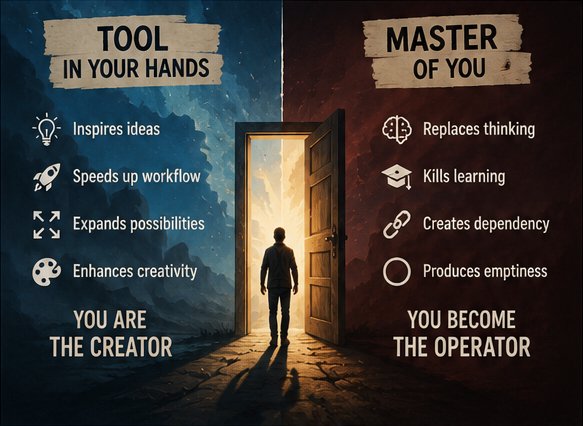
The same way a piano doesn’t play itself into a concert, and a DAW doesn’t magically produce a masterpiece just because it’s open on your screen, AI does not create meaning on your behalf. It generates possibilities. The meaning—if there is any—comes from what you do with those possibilities. But that requires involvement. It requires decisions. It requires understanding. Without that, you’re not using a tool. You’re outsourcing your role to it.
The Subtle Shift from Creator to Curator
There is a quiet transformation happening, and it’s not being talked about enough. Musicians are slowly becoming curators of machine output.
Instead of creating, they are selecting. Instead of building ideas, they are browsing them. Instead of struggling through imperfection and discovering something unique, they are choosing the most acceptable version from a set of generated options.
And while that may still produce something listenable, it raises an uncomfortable question, “Where exactly are you in the process?” If your contribution begins with a prompt and ends with a selection, then what you’ve done is closer to commissioning than composing.
The Confidence Without Foundation Phenomenon
Perhaps the most fascinating part of all this is the confidence it creates.
People who have never studied harmony are now evaluating chord progressions. Those who don’t understand orchestration are directing “cinematic scores.” Individuals who cannot explain why something sounds good are confidently generating “emotionally rich compositions.”
And why wouldn’t they?
The machine delivers results that sound convincing. It removes the friction, the doubt, the need to confront one’s own limitations, but it also removes the opportunity to overcome them. It’s like being handed the final answer to a complex problem without ever understanding the steps. Impressive on the surface, empty underneath.
Meanwhile, Musicianship Still Exists
People like A. R. Rahman didn’t arrive at their sound by avoiding the fundamentals. They immersed themselves in music—deeply, patiently, and relentlessly. They understood instruments not as presets, but as voices with character. They explored cultures, textures, and ideas with intent.
Technology, when they used it, was an extension of that understanding—not a replacement for it. If someone at that level engages with AI, it won’t be to generate something for them. It will be to explore something further. Because when you understand music, tools expand your expression. “When you don’t, tools define it for you.”
The Illusion of Progress
AI offers something incredibly seductive – speed. You can produce more in a day than you could in a week. You can explore variations instantly. You can generate, discard, and regenerate endlessly. It feels like productivity. But speed without depth is not progress. It’s just movement. If nothing is being learned, refined, or understood, then the output—no matter how polished—remains superficial. You may have ten tracks by the end of the day, “But you are still the same musician you were when you started.”
Where This Leaves Us
None of this means AI should be avoided. On the contrary, it is one of the most powerful creative tools we’ve ever had.
But like every powerful tool, its value depends entirely on how it is used. If it becomes your starting point—something you shape, question, and refine—it can elevate your work. If it becomes your endpoint—something you accept and publish—it will quietly replace you. And you may not even notice when that happens.
Final Reality Check
AI didn’t ruin music. It simply removed the excuses. So yes, use it. Explore it. Push it to its limits.
But remember this, “A tool is meant to serve your creativity—not substitute it.” And if your entire musical identity can be reduced to a well-phrased sentence…
Then you haven’t found your sound. You’ve just found better words.